

Oil is the single most important component to the existence of modernity, and, for globalization to continue, the crude must flow. Unfortunately, the ongoing U.S.-Israel-Iran Conflict is preventing globalization's equivalent of Dune’s spice from flowing. However, despite doomsday prognoses of $150 barrel oil, prices, until recently, remained below $90 a barrel since the announcement of the now-failed ceasefire agreement in late April.
While there are several factors at play that are helping keep oil prices within tolerable ranges such as Chinese petroleum reserves, increasing reliance on pipelines to Mediterranean and Red Sea ports, and oil tankers running the gauntlet of Iranian drones and missile batteries, a key factor impacting the perception of global oil markets is the U.S.’ Strategic Petroleum Reserve (SPR).
The Strategic Petroleum Reserve (SPR) was originally created due to the world’s first Middle Eastern oil crisis after OPEC placed an oil embargo on exports to the U.S. from 1973-1974 as retaliation for American support of Israel during the 1973 Arab-Israeli War. Commissioned by Congress in 1975, the SPR consists of 60 underground storage caverns across four sites in Texas and Louisiana with a total storage capacity of 713.5 million barrels.
Since 1985, a cumulative 500 million barrels of oil have been withdrawn through 2025 with over half occurring from 2014-2025. The largest single withdrawal in history occurred in 2022 in the wake of the Russia-Ukraine War after President Biden issued a 180 million barrel release that summer. The second largest release is occurring at present, with President Trump authorizing a draw down of 172 million barrels due to the U.S.-Israel-Iran Conflict. When completed, the SPR will sit at a total capacity of 243.4 million barrels, the lowest in 50 years. This leaves us with two questions: 1) How much longer until the U.S. completes the 172 million barrel release? 2) What is the minimum capacity of the SPR?
Answering these questions requires additional research into the operations of the SPR.
The SPR storage sites are located in underground natural salt deposits in Louisiana and Texas which were first created by using solution mining to create the storage space. While the underground storage method in salt caverns is safer and more affordable than other storage methods, it pose its own unique challenges. Specifically, as petroleum is withdrawn from a storage site, water is pumped into the caverns as oil will float to the top, helping improve flow rates. However, this same action degrades the storage sites overtime, necessitating maintenance.
In 2014, the Government Accountability Office (GAO) concluded that a large portion of the SPR had either reached or exceeded its 25-year design life and that preventative maintenance had been systemically deferred over the 15 years.1 Subsequently, in a 2015 report, the GOA recommended the Department of Energy (DOE) spend $1.4 billion to extend the lifespan of the SPR’s four storage sites by an estimated 25 years.2 Initially, it was expected for the Surface infrastructure Life Extension Phase 2 (LE2) project to be completed between 2022 to 2024, however, work for LE2 was not approved until 2021 and, by 2023, cost overruns forced the DOE to reduce the scope of LE2 to only three of the four storage sites and the timeline for completion extended to 2028.3
While all four sites are operational, the lack of preventative maintenance brings into question the minimum floor of the SPR. According to the DOE measurements as of September 11, 2026, the SPR capacity sits at 284.6 million barrels or 40% capacity. This leaves roughly 41.2 million barrels left of petroleum left in the current allocation of releases.
Since President Trump announced the 172 million barrel release on March 11, the average weekly drawdown rate averaged 5.3 million barrels. Withdraw rates peaked at an average 8.2 million barrels a week for the month of May but later declined to only an average 4.2 million barrels a week for the month of July in the aftermath of the now scuttled peace deal. At these withdraw rates, there are only between five to ten weeks of allocated withdraws left in the SPR. The midterm October surprise may be news that the SPR withdraw allocation is over.
That being said, it is vital to note that the allocation is not the hard floor for withdraws from the SPR. While Congressional statue notes that SPR capacity must be above 252.4 million barrels at all times, the same statute allows for further withdraws in case of federal emergency, of which the ongoing U.S.-Israel-Iran Conflict certainly qualifies. While the Trump Administration insists that the drawdown for the SPR can be as low as 70 million barrels, this reflects the most optimistic scenario.
SPR caverns are designed to accommodate up to five full withdraw events before questions of structural activity emerge. According to a 2025 survey by Sandia National Laboratories, a lifetime partner of the SPR, 47 of the 60 caverns had at least four full withdrawals remaining and only one cavern having a single full withdrawal event remaining.4 However, the bigger issue facing the SPR is not the structural integrity of the caverns but of the wells.
The SPR wells act as straws that allow for the petroleum to be readily accessible across multiple points. In the oil and gas industry, the average lifespan of a well is between 20-30 years. Of the estimated 120 access wells, the second youngest well is 38 years old.5 Although liners can extend the lifespan of the wells, the hands of time waits for no one and the Law of Entropy eventually makes it demands heard. Sandia notes curtly in a 2024 report that “well deformations are outpacing DOE’s ability to adequately reduce the risk of potential well failures”.6 Additionally, LE2 centered around surface infrastructure and did not include any work on wells, further highlighting the inability of the DOE to maintain the SPR since 2014.
As the SPR continues its withdraws, the demands upon the system as a whole grows also. The storage levels of the SPR are at historical lows not seen since it was first filled, and the stresses of such major withdraws increase the odds of something going wrong, either with the wells or even the caverns. Indeed, there is recent evidence that the U.S. may be facing problems withdrawing oil from the SPR.
Over the past six weeks, there is a steady decline in the rate of withdraws from the SPR that do not align with geopolitical realties. For instance, over the past few weeks, the world witnessed a new offensive by the Houthi’s threatening Red Sea naval traffic and the bombing of the Saudi East-West Pipeline which has knocked out 4 million barrels a day of rerouted oil flows due to the U.S.-Israel-Iran Conflict, 4% of total global oil production. Under such circumstances, it would be expected for SPR releases to at least remain static if not increase. Instead, weekly releases are declining.
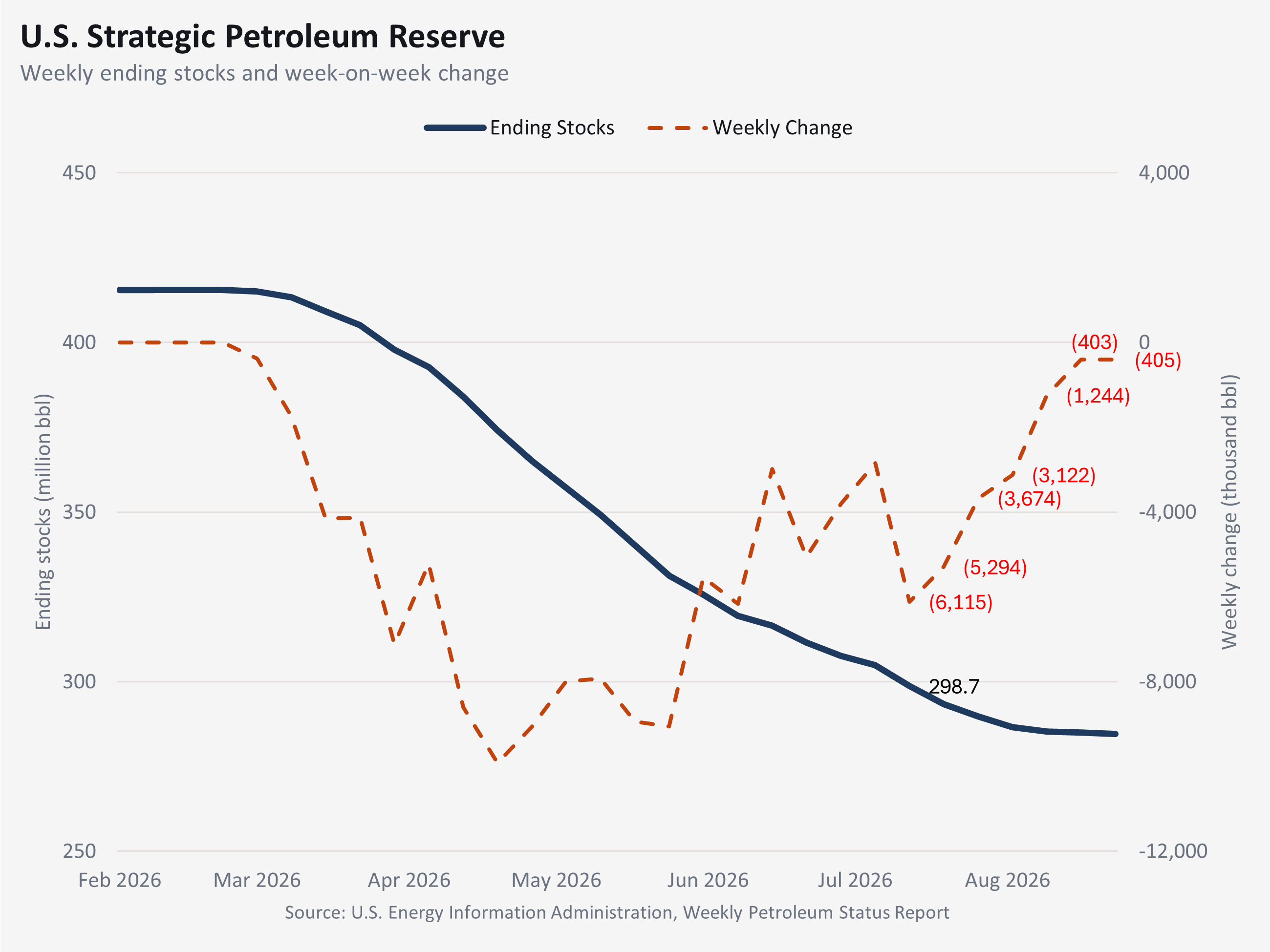
A picture is worth a thousand words. Again, the pattern of SPR release shows that releases gradually accelerated through May before declining following the announcement of ceasefire negotiations and then again accelerating in July after negotiations failed. However, what is not expected is that releases are now declining rapidly ever since SPR reserves declined below the 300 million barrel threshold.
This is reason for concern.
In August, Siddharth Misra, a petroleum engineering professor at Texas A&M University, noted “the practical operational floor for the crude inventory is between 250 million and 300 million barrels” as the layers of oil thins which increases the risk of sludge damaging the pipes and pumps of the SPR. Furthermore, while the SPR has seldom experienced full releases of its caverns, it has undergone numerous partial releases which creates potentially unseen damage to the structural integrity of the wells and caverns thereby lowering the effective operational capacity of the SPR. This view is echoed by Rapidan Energy which notes the soft floor of the SPR is around 170 million barrels.
For a solid two weeks, the SPR releases have been at 403,000 and 405,000 barrels a week respectively when releases should be ten times that amount. This suggests that the SPR is facing major issues either with the pipes and pumps or - even worse - structural concerns with the wells and caverns. Either way, if this assertion is correct, the SPR is rendered effectively useless. The SPR can no longer serve as a mechanism of insulating the U.S. from world oil prices. This is compounded by the fact that, even if the U.S.-Israel-Iran Conflict ends tomorrow, it will take months for oil markets to normalize.
Given the fact that U.S weekly SPR releases amount to millions of barrels a week whereas the world oil markets suffering from a deficits of million of barrels a day, the impact to overall global supplies is limited. However, a failure of the SPR to serve as intended is a massive blow to consumer confidence and a blow to the legitimacy of the Trump Administration in an already contentious midterm cycle in an increasingly beleaguered Presidential term.
It is impossible for the general public to know for certain why SPR release rates have precipitously declined, yet, given the available evidence, the prognosis is does not leave one optimistic. Regardless, it seems almost certain that U.S. energy markets will continue to worsen before the weary American consumer finds relief at the pump.
United States, Government Accountability Office. Energy Security: Congress and DOE Need a Unified Plan to Align Priorities and Investments for the Strategic Petroleum Reserve. GAO-26-106918, 29 May 2026, www.gao.gov/assets/gao-26-106918.pdf.
IBID.
IBID.
IBID.
IBID.
IBID.